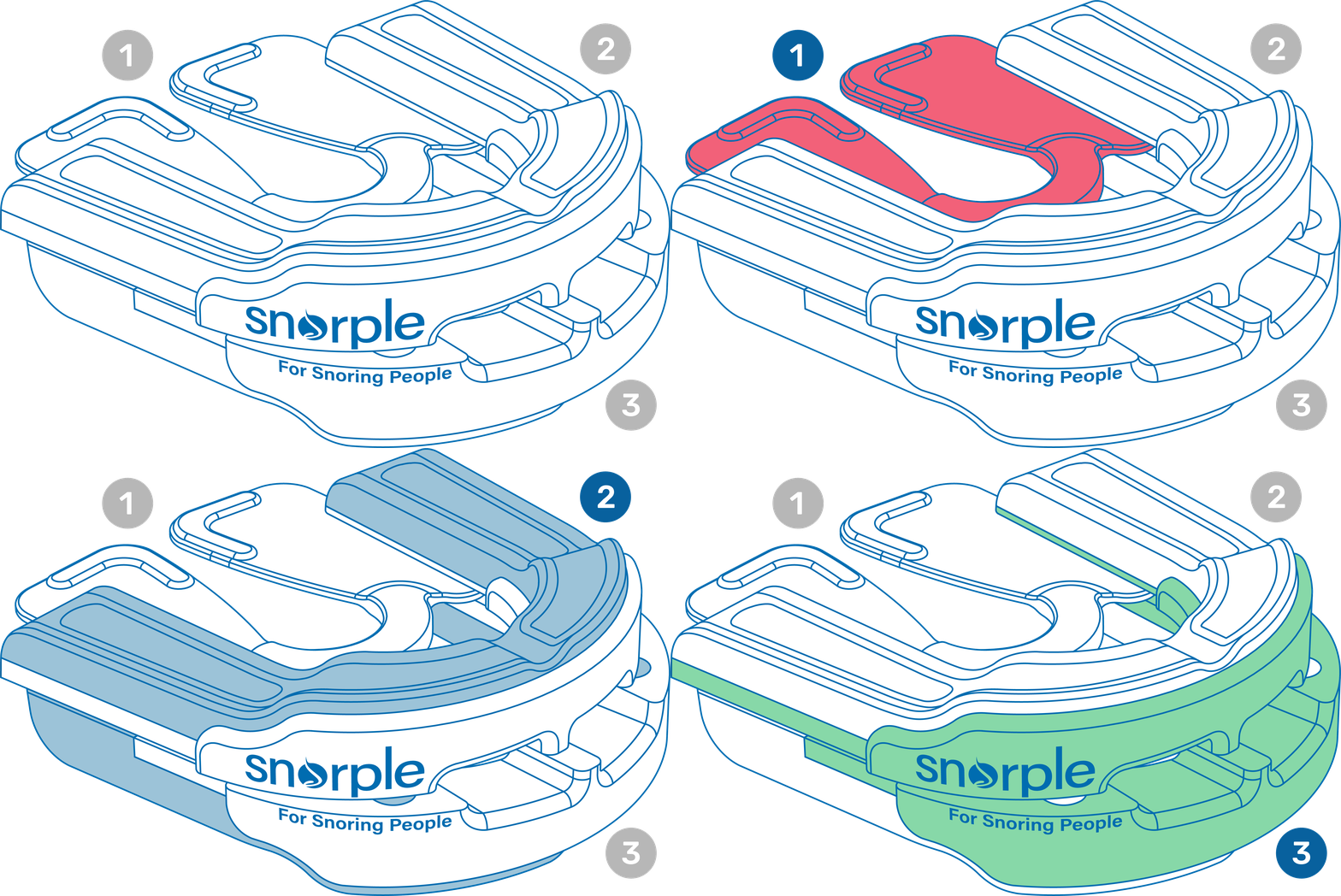
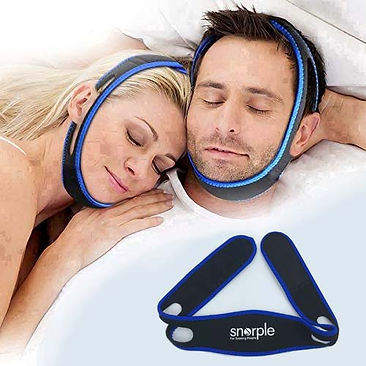
The complete snoring solution. Our custom-fit mouthpiece advances your jaw and stabilizes your tongue, while the adjustable chinstrap keeps your mouth closed and encourages nasal breathing. Dual-action protection — the most effective way to stop snoring permanently.
⚠️ Not suitable for everyone. Do not use if you have diagnosed obstructive sleep apnea, severe TMJ disorder, full dentures, or recent jaw surgery. The chinstrap component is not recommended for those with skin sensitivities to fabric. If you have any doubt, consult your doctor before use. See full safety FAQ →
Real People. Real Transformations.
Before and after using the Snorple Combo — in their own words
Before the Combo
"I had the mouthpiece alone for a month — helped a lot but I kept waking myself up mouth-breathing. My wife said I still made a low rumbling sound. We weren't satisfied yet."
After Adding the Chinstrap (Week 2)
"Complete silence. The chinstrap closed the last gap — literally. My wife recorded me. Zero audible sound for the first time in our 11 years of marriage. She cried. I cried."
— Derek F., 51, Denver CO
Verified post-purchase review
Before the Combo
"I'm a chronic mouth breather because of allergies. I'd tried two other MAD devices and they both failed because my jaw kept dropping open. I woke up dry-mouthed and hoarse every morning."
After the Combo (Night 4)
"The chinstrap solved the exact problem the mouthpiece couldn't fix alone. No more dry mouth, no more morning hoarseness. I sleep through the night and wake up feeling human again."
— Sandra K., 44, Tampa FL
Verified post-purchase review
Before the Combo
"My husband snored so badly I was literally considering separate bedrooms. We'd been arguing about it for 2 years. Nothing worked — nasal strips, positional pillows, white noise machines. All just band-aids."
After the Combo (Week 3)
"Three weeks in, we're sleeping together every night again. He uses both pieces and I genuinely can't hear him. It's the best $74.95 we've ever spent. I wish we'd found this sooner."
First night with the combo — total silence. She actually cried. We both slept through the night for the first time in three years. Back in the same bed. Worth every single penny and then some. The mouthpiece + strap together is the real game changer.
Marcus T.
Snorple:
Marcus, this is everything. Thank you for sharing — this is exactly why we built the combo. Enjoy those mornings together. 💙
★★★★★
✓ Verified Purchase
"The combo is 100% worth the extra cost"
I bought the mouthpiece first and it was good but my husband still had occasional snoring because he's a mouth breather. Upgraded to the combo — snoring completely gone. If you breathe through your mouth, do not skip the chinstrap.
Susan L.
★★★★★
✓ Verified Purchase
"Blood oxygen levels improved significantly"
My doctor told me I was heading toward a CPAP. I tried the combo as a last resort. Three months later at follow-up, my blood oxygen levels during sleep improved significantly. My doctor said keep doing whatever you're doing.
Richard H.
Snorple:
Richard, this kind of feedback genuinely means everything to us. Please do keep your doctor informed as you continue — this is exactly the outcome we hope for every customer.
★★★★★
✓ Verified Purchase
"Finally no more dry mouth either"
I used to wake up with terrible dry mouth every morning. The chinstrap keeps my mouth closed so I breathe through my nose all night. No more dry mouth, no more morning breath, no more snoring. Three problems solved in one purchase.
Lisa K.
★★★★☆
✓ Verified Purchase
"Takes a few nights but absolutely works"
Night 1 was an adjustment. By night 3 I had both pieces working together perfectly. By week 2 my wife stopped wearing earplugs. The chinstrap is the missing piece that makes the mouthpiece even more effective.
Frank D.
Snorple:
Frank, you nailed it — the two pieces work synergistically. The chinstrap reinforces the nasal breathing the mouthpiece sets up. Glad you pushed through the adjustment!
★★★★★
Not Verified
"Bought for my dad, he loves it"
Bought this as a gift for my dad who has snored my entire childhood. My mom called me a week later just to say thank you. Dad says it took two nights to adjust and now he says he sleeps better than he has in 20 years.
Anne W.
★★★★★
✓ Verified Purchase
"Best purchase of the year"
I've tried three other anti-snoring devices. None of them worked consistently. The Snorple combo works every single night without fail. The custom fit is key — it's not a generic one-size device. My wife stopped complaining the first week.
Steven B.
Snorple:
Steven, the custom fit really is what makes the difference — glad you finally found what works. Here's to many more quiet nights!
★★★☆☆
✓ Verified Purchase
"Works well, chinstrap needs adjustment most nights"
The mouthpiece is excellent. The chinstrap I need to re-adjust most nights before it feels right. Not a big deal but worth noting. Overall snoring is reduced about 95% which I'm very happy with.
Terry N.
Snorple:
Hi Terry — the strap adjustment should become quicker over time as you find your ideal fit position. If you're still having trouble after a few weeks, reach out to us and we'll walk you through a fitting adjustment!
Mandibular advancement devices like the Snorple mouthpiece are proven to reduce snoring in the majority of patients. Multiple peer-reviewed studies confirm their effectiveness for mild to moderate obstructive sleep apnea and primary snoring.
We stand behind every product we make. If you don't experience a meaningful reduction in snoring within 100 nights, we'll refund your purchase in full — no questions asked. We're that confident the combo will work for you.
The Snorple Combo combines both the custom-fit mouthpiece (which advances your jaw) and the anti-snoring chinstrap (which holds your mouth closed) for dual-action snoring prevention. This complete system addresses two root causes simultaneously — airway obstruction and mouth breathing — making it the most effective anti-snoring solution in the Snorple lineup.
Is the Snorple Combo a good alternative to CPAP?
For people with mild to moderate snoring or sleep apnea who want a non-invasive CPAP alternative, the Snorple Combo is an excellent option. It's silent, requires no power, no mask, and no machine — just wear it to bed. Many users with diagnosed mild sleep apnea find it equally effective with far greater comfort.
How much does the Combo cost compared to buying separately?
The Snorple Combo is $74.95, compared to $59.95 for the mouthpiece alone and $29.95 for the chinstrap alone — a saving of $14.95 versus buying both separately. All Snorple products include free shipping and a 100-night money-back guarantee.
Can I use the Combo if I am a mouth breather?
Yes, the Combo is actually the ideal choice for mouth breathers. The chinstrap keeps your mouth closed to promote nasal breathing, while the mouthpiece advances your jaw to keep the airway open. Together they address both issues that commonly cause mouth-breathing snoring.
What is the Snorple 100-night guarantee?
Every Snorple product — including the Combo — is backed by a 100-night money-back guarantee. This is the longest guarantee in the anti-snoring market. ZQuiet offers 60 nights and SnoreRx only 30 nights. If you're not happy within 100 nights, we refund you in full, no questions asked.
How to Set Up the Snorple Complete System
Both pieces work together — takes about 10 minutes total to fit.
1
Heat water for the mouthpieceHeat water to 70–80°C (158–176°F) — do not boil. A microwave works well, about 90 seconds for a standard mug.
2
Fit the mouthpieceSubmerge 30 seconds until pliable, cool briefly 2–3 seconds, bite down for 30 seconds to create your custom impression, then set in cold water.
3
Set your jaw advancementUse the included hex key to dial in your starting advancement at 50–60% of your comfortable maximum. Increase by 0.5–1 mm increments over the following nights.
4
Fit the chinstrapSlide the chinstrap over your head, center the chin cup under your jaw, and secure the fastener so your mouth stays comfortably closed.
5
Wear both togetherInsert the mouthpiece first, then position the chinstrap over it. The mouthpiece repositions the airway while the chinstrap prevents mouth breathing and adds jaw support.
Medical Disclaimer: The information on this page is for educational purposes only and is not a substitute for professional medical advice, diagnosis, or treatment. If you suspect sleep apnea or another sleep disorder, consult a qualified healthcare provider before using any anti-snoring device.

.webp)

_edited.png)
.webp)
.webp)
.webp)
_edited.png)